
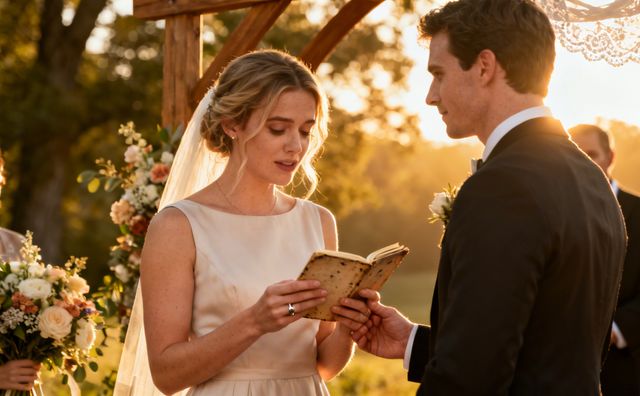
Intentional Vows: Crafting Words That Last a Lifetime
How to Write Authentic Vows that Reflect Your Relationship
Why Intentional Vows Matter

When I talk about “intentional vows,” I mean words that are chosen on purpose,
not just repeated because everyone always says them, and they come from your
real story, your real faith, and your real hopes for marriage instead of a
generic script that could fit any couple. Traditional vows like “for better or
worse, for richer or poorer” are beautiful and I respect them, but they can
become empty if we say them without thinking through what they actually mean in
daily life. Intentional vows slow you down and make you ask, “What am I truly
promising, and why?” They sound like you, they fit your relationship, and they
connect your wedding day to the kind of husband or wife you want to be 5, 10, or
50 years from now. In short, intentional vows turn your ceremony from a
performance into a deeply personal covenant you both understand and own.
Thoughtful vows matter because they quietly lay the foundation for how you will
treat each other when nobody is watching and the wedding flowers are long gone.
When you stand up in front of God, family, and friends and say specific, honest
promises, you are not just filling time in a program; you are setting the tone
for how you will handle conflict, stress, money, parenting, and even the boring
chores. Clear, intentional promises build trust because you both know exactly
what you’re aiming for, instead of guessing based on movies or social media.
Over the long run, those words become a reference point you can return to when
marriage feels heavy or confusing, like a compass pointing you back to the kind
of love you chose to give. A thoughtful vow does not guarantee an easy marriage,
but it gives you a shared language to fight for your commitment together.
Vows are more than pretty sentences; they are a snapshot of who you are as a
couple, what you believe, and what kind of home you want to build. Different
cultures have different wedding customs, but almost everywhere, some form of
promise sits at the center, because people know deep down that love is not just
feelings, it is commitment and identity. As a Christian, I see vows as a
covenant before God, not just a legal contract, so the words carry spiritual
weight as well as emotional meaning. Your vows can quietly show your values:
maybe you highlight teamwork and equality, or you focus on respect and headship,
or you stress hospitality and serving others together. Whatever your beliefs,
the way you phrase your promises shows your guests, “This is who we are and what
matters to us,” and it reminds you both that your marriage is part of something
bigger than just romance.
When my husband and I got married, writing my own vows felt important because I
wanted my words to match the faith and calling I believe God gave me as a wife.
I didn’t want to copy a Pinterest board or say something trendy that I would not
stand by when we were tired, broke, or overwhelmed with kids later. I remember
sitting with my notebook and Bible, praying, “Lord, what should I promise this
man?” and feeling the weight but also the sweetness of that question. I wrote
about honoring him, supporting his leadership, and building a home where Christ
is at the center, because that was real to me, not something a wedding planner
suggested. Looking back now, through newborn nights and messy days, I am
grateful I took the time to be intentional, because those words still echo in my
mind when loving well is hard work.
Finding Your Voice: What Makes Vows Authentic
The first place to start when writing your vows is not Google; it’s you, your
real self, and how you normally speak to your partner. Your vows should sound
like your voice, whether that’s simple and quiet or loud and playful, and you
don’t need to force big poetic lines if that isn’t how you talk. Ask yourself,
“Who am I as a person and as a wife or husband? Am I the steady one, the
dreamer, the planner, the encourager?” Then think, “How do I show love right
now, and how do I want to grow?” When your words match your true personality,
your promises will feel honest instead of like a performance, and your spouse
will recognize you in every line. Remember, you are not trying to impress your
guests; you are speaking heart to heart with the person you are choosing for
life.
A simple way to make your vows feel authentic is to pay attention to the words
and memories that already fill your daily life together. Maybe you both have a
phrase you say when things go wrong, a nickname that shows tenderness, or a
routine like Saturday coffee on the porch that means more than fancy dates.
Write down these small details, because they carry the flavor of your real
relationship, and you can weave them into your promises. For example, if you
always say “we’re a team,” you might promise, “I will choose ‘team us’ even when
I feel frustrated or tired.” If you always walk the dog together, you can
mention continuing those little walks in your old age. These real-life touches
make your vows feel rooted in the life you already share and the life you hope
to build.
It’s tempting to pull lines from movies, songs, or social media posts, but
borrowed words can easily feel shallow if they don’t truly match your story.
There is nothing wrong with including a quote that genuinely shaped your
relationship or faith, but you should ask, “Does this line really capture what I
want to say, or am I just using it because it sounds romantic?” If the only
reason you like a quote is because it’s famous or dramatic, it may not age well
when you are arguing about dishes or diapers. Instead of leaning on someone
else’s poetry, try to say the same truth in your own language, even if it comes
out simpler. Honest and slightly clumsy words are better than polished lines
that never belonged to you.
One special way to make your vows deeply personal is to include a single line
that only your partner will fully understand, something connected to a private
moment or promise between you two. It might be a reference to a hard season you
walked through, a dream you whispered late at night, or a small act of kindness
they did that changed how safe you felt with them. You can mention it in a way
that still makes sense to guests, but carries extra weight for your spouse,
like, “I will always choose you, even on the ‘parking lot days,’” if that phrase
means something specific in your story. That one hidden layer tells your
partner, “I see you, I remember us, and I treasure what we’ve been through.”
Those little inside truths can make them tear up faster than any flowery line.
Structure Your Vows: Simple Frameworks That Work
A simple framework that helps many couples is to shape your vows around the
past, the present, and the future, so your words tell a clear story. In the past
part, you share briefly how you met, what drew you to your partner, or a moment
when you knew this love was different, focusing on gratitude rather than a long
history lesson. In the present, you speak about who you are now together and
what you are promising at this altar today, like choosing forgiveness, loyalty,
and kindness even when feelings go up and down. In the future, you look ahead to
the kind of husband or wife you commit to becoming, mentioning hopes for your
home, family, and faith, and the habits you will keep choosing. This three-part
flow keeps your vows grounded in reality, not just dreamy words, and helps you
stay focused instead of rambling.
To make writing easier, it helps to have some starter lines and transitions you
can customize. For opening lines, you might say, “From the moment I first saw
you…” or “I never expected to find you when I did, but…” or “Standing here
today, I am thankful for every step that brought us to this moment.” For
transitions from past to present, try, “Because of all we’ve walked through,
today I promise…” or “Knowing who you are and how we’ve grown, I vow…” For
closing promises, you can use phrases like, “For as long as God gives us
breath,” or “I choose you today and every day after this,” or “This is my solemn
vow, with all my heart.” These simple, clear lines give structure while still
leaving room for your personal story and faith.
When it comes to length, speaking your vows out loud should usually take around
60 to 120 seconds, which is about one to two solid paragraphs when read slowly.
That might sound short, but once you are standing there, full of nerves and
emotion, it will feel plenty long enough for both you and your guests. If your
vows go on for five minutes, people may lose focus, and you might struggle to
keep your thoughts clear. Aim for a few powerful, honest promises instead of
trying to cover every memory and feeling you have ever had. Remember, your whole
marriage is the place where you will live these words out; the ceremony is just
the starting point.
Your vows do not need to sound like Shakespeare to be meaningful; they just need
to sound like you on your most sincere day. Try to avoid overly flowery words
you would never say in real life, because they can come across as fake or
dramatic when spoken out loud. Instead, choose simple, direct language, like “I
promise to be faithful,” “I will listen before I speak,” or “I will stand beside
you when life is hard.” Before you finalize your words, read them out loud a few
times; if you trip over a phrase or feel silly saying it, adjust it until it
feels natural. The goal is clarity and honesty, not impressing anyone with your
vocabulary.
If you feel stuck, you can use a basic vow outline and then tweak it to fit your
personality, whether you’re serious, playful, shy, or bold. For example: 1) One
or two sentences about how you met or what you first noticed, 2) Two to four
sentences about what you love and admire in your partner, 3) Three to six clear
promises that cover your faith, your daily life, and your long-term commitment,
4) One closing line that points to your lifelong covenant. A more playful person
might add a light, respectful joke in one promise, while a very reserved person
may keep it plain and steady. You are free to shape the outline to match you,
but having these steps gives you a path so you are not staring at a blank page.
Faith and Values: Including Spiritual Promises

If you are a believer like I am, you may want your vows to reflect your faith,
but you also don’t want them to feel like a sermon, and that balance is possible
when you focus on your own walk with God. Instead of preaching at your spouse
during the ceremony, speak about how you personally want to live out your faith
in this marriage, like, “I will seek God first and ask Him to help me love you
well,” or “By God’s grace, I will honor this covenant as long as I live.” You
can also quietly acknowledge that marriage is bigger than just romance, saying
something like, “I believe God brought us together for His purposes, and I
promise to steward this gift with humility.” Keeping the focus on your own heart
and actions keeps your vows tender and sincere, not pushy.
Faith-centered promises can be beautiful and very practical when they touch
daily habits that shape your life as a couple. You might promise to pray with
and for your spouse, especially when you face big decisions or deep hurts,
saying, “I will bring our joys and struggles to God in prayer with you.” You can
vow to serve your future family together, like, “I will stand beside you as we
raise our children to know and love the Lord,” or “Together we will open our
home to others and show Christ’s love.” Other faith-based lines could include
commitments to stay plugged into a church, to forgive quickly because you have
been forgiven, or to handle money in a way that honors God. These promises point
your marriage in a clear spiritual direction.
If your faith backgrounds are different, or if some guests are not believers, it
helps to choose spiritual wording that is honest but also respectful and clear
for both of you. You do not want to publicly promise something your spouse does
not agree with or understand, so talk ahead of time about what level of faith
language feels right for you both. You might say, “I thank God for you,” or “I
believe God is at work in our story,” which expresses your heart without forcing
heavy theology into the ceremony. Avoid making spiritual promises on behalf of
your partner, like “We will always do devotions together every morning,” if that
isn’t realistic or fully shared yet. The goal is to be truthful, kind, and
united in the words you speak, even if your spiritual journeys are in different
places.
Personal Stories: Choosing Moments to Include
One powerful way to make your vows feel alive is to pick one or two short
memories that reveal your partner’s character, not just how attractive or fun
they are. Maybe you remember the way they showed up when a family member was
sick, how they stayed up late helping you study or prep for work, or how gently
they cared for a child or an elderly relative. These small scenes show what kind
of husband or wife they already are and help you explain why you trust them with
your heart. Instead of telling a long story, you can say, “I knew your kindness
was real when…” followed by a brief picture that highlights their loyalty,
patience, or courage. That one memory can say more about your future together
than ten generic compliments.
Try to choose memories that led to real growth in your relationship or deepened
your love, not just funny or glamorous moments. You might think of the first big
argument you worked through and how they listened and apologized, or a time when
you were discouraged and they spoke truth and hope into you. Maybe it was a
season of financial stress when they stayed steady instead of panicking, or a
time you saw them stand up for what is right even when it was not popular. When
you mention those moments, you are saying, “I saw who you really are in hard
times, and I still choose you.” These kinds of memories connect your vows to
tested character, which matters so much more than perfect dates.
Inside jokes can be sweet in private, but during vows, too many secret
references can leave your guests confused and pull attention away from the heart
of your promises. If you spend half your vows talking about a nickname or a
silly moment that nobody else understands, it may feel more like a private
comedy show than a public covenant. A light hint of shared humor is fine, as
long as the main focus stays on honoring your spouse and making clear promises.
Ask yourself, “If someone didn’t know us at all, would this line still show them
that I respect and cherish my partner?” If the answer is no, save that joke for
later and keep your vow words meaningful, not exclusive.
Balancing Romance and Practical Promises

Strong vows often weave together two kinds of lines: poetic or emotional
statements and very concrete promises about how you will live day to day. You
might say something tender like, “You are my safe place and my greatest earthly
gift,” and then follow it with something practical like, “I will listen to you
fully before I answer, and I will stand with you when we face hard choices about
money, work, or parenting.” The poetic parts touch the heart and remind your
spouse that they are cherished, while the concrete parts give them solid ground
to stand on when life gets messy. It’s that mix of beauty and practicality that
makes your vows feel both romantic and reliable.
At least one or two of your promises should be extremely practical, the kind of
things that will matter every single week in your home. This might include
sharing certain chores, working together on a budget, making space for weekly
check-ins, or protecting a date night even in busy seasons. You could promise,
“I will stay committed to talking about our money openly,” or “I will put my
phone away at dinner so I can be present with you.” These simple lines may not
sound as dramatic as “I’ll climb the highest mountain,” but they are the kind of
promises that actually shape your peace and unity. Small,
steady acts of faithfulness are the backbone of a strong marriage.
Your vows should also be honest about what you can realistically give, not a
list of big, dramatic promises that you cannot sustain. If you promise “I will
never hurt you” or “I will always be perfectly patient,” you are setting both of
you up for disappointment, because we are human and we all fail at times.
Instead, you can promise to repent, to seek help when you’re stuck, and to keep
fighting for your marriage even when you don’t feel like it. Saying something
like, “I will fail you sometimes, but I will not give up on us, and I will keep
turning back to God and to you,” is humble and real. Honest vows create room for
grace and growth instead of pretending you will be a flawless spouse.
When you phrase your promises, try to use strong, active language like “I will,”
“I choose,” or “I commit,” instead of softer phrases like “I hope to” or “I’ll
try to,” which can sound unsure. “I will” does not mean you will never mess up;
it means this is the direction of your heart, the standard you are aiming for
with God’s help. For example, “I will speak well of you in public and in
private,” or “I will guard our marriage from anything that threatens our unity.”
These are clear statements that show your spouse and your guests that you are
serious about your responsibility. Strong wording does not make you harsh; it
makes your covenant steady and weighty, as it should be.
Writing Exercises and Prompts to Get Started
If you feel stuck, using simple prompts can unlock memories and feelings you
didn’t realize you wanted to say out loud. Try writing a few sentences to finish
lines like, “The moment I knew I loved you was…,” “What I admire most about you
is…,” and “A promise I need to make to you is….” You can also add prompts like,
“One way you have changed me for the better is…,” or “When I picture us 20 years
from now, I see….” Don’t worry yet about perfect wording; just let your heart
answer those questions honestly, and you’ll gather rich material to shape into
your vows later. These prompts help you move from vague feelings to actual
sentences you can hold on to.
A timed free-writing session is one of the best tools I’ve used for any kind of
writing, including vows, because it pushes you past perfectionism and
overthinking. Set a timer for 5 to 10 minutes, choose one or two prompts, and
then write without stopping, crossing out, or editing, even if what you write
feels messy. The goal is to get your real thoughts down before your inner critic
shows up and tells you it’s not “wedding pretty” enough. You might be surprised
what comes out when you give yourself permission to be honest and a little
unpolished. Later, you can go back with a calm mind and highlight the lines that
truly capture your heart.
It can be very helpful to show a draft of your vows to someone you trust, like a
close friend, a married couple you respect, or a pastor who knows you both. Ask
them, “Does this sound like me? Is anything confusing, too personal, or unkind?”
They can help you spot areas where you might be oversharing, using jokes that
land wrong, or making promises that aren’t realistic. A wise mentor can also
suggest ways to gently include your faith, your values, and your long-term
vision if those parts feel hard to express. You don’t have to take every
suggestion, but a caring outside eye can help your vows stay both honest and
appropriate.
Once you have a page of free-writing and feedback, you can turn it into a clear
vow paragraph using a simple template. Start with one or two sentences that
capture how you met or when you knew this relationship was different, pulling
from your “moment I knew I loved you” notes. Then choose two or three of your
strongest admiration statements, like “What I admire most is…,” and place them
together. Next, pick three to five promise sentences that begin with “I will” or
“I commit,” especially the ones that fit your daily life and your faith.
Finally, close with a single sentence that sums up your long-term commitment,
like “As long as we both live, I choose you.” When you plug your raw writing
into this structure, a personal, focused vow almost writes itself.
Dos and Don'ts: Common Pitfalls and Best Practices

Some simple “dos” can help you shape vows that are powerful without being
overwhelming. Do be specific about what you love and what you promise, using
real examples rather than vague statements. Do practice your vows out loud
several times so you can hear how they flow, fix any tongue-twisters, and get
comfortable with the emotions that may come up. Do keep your vows personal and
concise, focusing on a handful of meaningful points instead of trying to cover
your whole life story. And do talk with your partner or officiant about general
length so your vows feel balanced with each other.
There are also a few clear “don’ts” that protect your vows from becoming awkward
or hurtful. Don’t turn your vows into a long list of conditions, demands, or
rules your spouse must follow to keep you happy; this is a time for your
promises, not their duties. Don’t use harsh or embarrassing humor about past
mistakes, exes, or sensitive topics, because your spouse may feel shamed in
front of loved ones. Don’t overshare private details that belong in your living
room, not at the altar. And don’t secretly plan some big surprise speech that
your partner might find uncomfortable; honor their dignity and the sacredness of
the moment.
Sometimes couples feel tempted to use vows as a place to fix past hurts, pile on
apologies, or explain complicated issues, but that usually adds confusion
instead of healing. If there are deep wounds or unfinished conversations in your
relationship, those need to be handled in private, with honesty and maybe
counseling, long before the wedding day. In your vows, you can gently
acknowledge that you are imperfect and that you’ve already walked through hard
seasons, but keep the focus on hope and commitment, not on airing old pain. If
you need to say “I’m sorry” in a big way, do that heart to heart, not in front
of a crowd that may not understand the full story. Your vows are a place to move
forward together.
Because emotions run high on a wedding day, it is wise to have a printed copy of
your vows, even if you think you’ve memorized them perfectly. Tears, nerves, and
distractions can make your mind go blank faster than you expect, and holding a
simple card or paper can be a huge comfort. Print in a font size that is easy to
read, or write neatly by hand, and give a backup copy to your officiant just in
case. There is nothing unromantic about glancing down to stay on track; it
simply shows that your words matter enough to prepare. Your spouse will remember
your heart and your promises, not whether you had to look at a page.
Rehearsal and Delivery: How to Practice
If possible, try to practice your vows in a setting similar to where you will
say them, especially with a microphone or in the actual ceremony space. Stand
where you’ll stand, hold your paper or card, and speak toward an empty chair or
a friend so you can feel how your voice carries. This helps you notice little
things like where to place your hands, how loudly to speak, and how to handle
any echoes or background noise. Getting used to the space ahead of time can calm
your nerves on the wedding day, because nothing will feel totally new to you.
When you practice reading your vows aloud, focus on speaking with natural
emotion but steady pacing, letting yourself feel the weight of your words
without rushing or mumbling. Aim for a clear, medium speed, and pause briefly
after important lines to let them sink in for your spouse and guests, and to
give yourself a moment to breathe. If you think a line may bring laughter or
tears, give it a tiny extra pause before you continue so you’re not talking over
the reactions. Remember, this isn’t a race; tender, unhurried speech shows that
you respect the promises you are making. You don’t have to be a performer; you
just need to be present and sincere.
It can help to rehearse your vows twice: once alone, and once in some form with
your partner, even if you don’t reveal every word ahead of time. Alone, you can
practice without feeling self-conscious, adjust your body language, and make
sure you’re comfortable with any emotional parts. With your partner, you can
talk about length, tone, and any parts you want to coordinate, like faith
references or light humor, without spoiling all the surprises. This shared
preparation builds confidence, because you both know you’re working toward the
same kind of moment. Going into your ceremony as a team, even in this, is a
sweet way to start your marriage.
After the 'I Do': Keeping Vows Alive

Your vows don’t have to live only in your wedding video; you can bring them into
your everyday life through simple traditions. You might print and frame a
favorite line to hang in your bedroom, or keep both sets of vows in a special
box with your rings, invitations, or dried flowers. Some couples choose to
reread their vows every anniversary or on New Year’s, using that time to thank
God for how He has helped them grow. Others copy a key promise into a journal
they share and add notes each year about how they’ve seen that promise lived
out. These small habits keep the memory of your commitment close and visible.
Beyond special moments, you can set gentle weekly or monthly reminders to live
out specific promises you made at the altar. If you vowed to pray together, you
might set aside one evening a week to do that, even if it’s short. If you
promised to speak well of each other, maybe once a month you check in and ask,
“Have my words been building you up or tearing you down?” You could set a
reminder on your phone with a short line from your vows that pops up every
Friday, nudging you to choose kindness or patience. These small cues don’t make
your marriage perfect, but they can help you keep your heart pointed in the
right direction.
Over time, serious vows slowly turn into everyday habits that can quietly
strengthen your marriage in ways other people may never see. A promise to listen
before reacting becomes the choice to slow down in a tense moment and really
hear your spouse. A vow to handle money together becomes weekly or monthly
budgeting meetings where you share goals instead of hiding purchases. A
commitment to serve your family becomes simple acts like making breakfast,
folding laundry, or putting your phone away when your kids need you. These
habits are not flashy, but they are the daily ways you live out the big words
you spoke on your wedding day.
As a wife and mom who has watched our vows stretch through messy seasons, I want
to encourage you that your wedding words don’t have to be perfect to be
powerful; they only need to be honest and backed up by faithful effort. You will
not keep every promise perfectly, and there will be days when you feel more
frustrated than romantic, but that doesn’t mean your vows have failed. In those
moments, you can go back to what you said, ask God for grace, and choose again
to love the person in front of you. Intentional vows are not magic spells; they
are a starting point for a lifetime of choosing each other. If you write and
live them with humility and courage, they can help anchor your heart for many
years to come.